Best Native Trees to Plant on Your MidCoast Property (And What to Avoid Near Your House)
Choosing a tree for your garden sounds simple. Then you stand in the nursery, looking at fifty different pots. The MidCoast has its own soil, rainfall, and council rules. A tree that thrives in a Sydney courtyard is not always a good fit for a block in Taree, Forster, or Gloucester.
Native trees are usually your best bet. They are used to our weather and soil. They also support the birds, possums, and koalas that already share the MidCoast with us. But “native” does not automatically mean “safe to plant anywhere.” Some natives still need plenty of room. A few popular trees, native and introduced, can cause real damage if they end up too close to your house, your pipes, or the powerlines.
This guide covers which native trees do well on MidCoast properties. It explains how far to keep them from your house and underground services. It also covers which trees are better left out of the garden altogether.
Key Takeaways
Indigenous natives (species that grew locally before European settlement) generally need less water, less fertiliser, and less fuss than other trees once established.
Match the tree to the space: small trees under 6 m suit tight yards, larger trees over 10 m need open ground well away from the house.
Keep large trees at least 10–15 m from foundations, 15 m from powerlines, and 10 m from a septic tank or drainage field.
In bushfire-prone areas, keep oily species like eucalypts and melaleucas at least 15 m from the house, and use fire-retardant natives like Pigface or Water Gum closer in.
Avoid Camphor Laurel, Privet, Cocos Palm, Coral Tree, Radiata Pine, willows, poplars and large figs near the house, they either damage property or crowd out native bush.
Planting a tree rarely needs council approval, but once it grows past 5 m or 600 mm trunk girth, removing or pruning it later will.
1. Native or Indigenous? Why It Matters for MidCoast Gardens
“Native” and “indigenous” get used as if they mean the same thing. But there is a difference. A native tree grows naturally somewhere in Australia. An indigenous tree grew naturally in your local area before European settlement. It is usually the safer bet for a MidCoast garden, since it has adapted to our exact soil and rainfall over a very long time. That generally means less watering, less fertiliser, and fewer problems once it settles in.
One thing worth knowing before you plant: skip phosphorus-heavy fertilisers such as blood and bone. Sensitive natives like Banksia and Acacia can suffer root burn from too much phosphorus. If a young native tree does need feeding, look for a low-phosphorus formula. Under 3% phosphorus is the general guide.
2. Best Native Trees to Plant, by Size
The right tree depends on how much room you have and what you want it to do. Maybe you want shade, screening, a windbreak, or just something nice to look at. Here are some reliable native options for MidCoast gardens, grouped by their mature size.
Small Trees for Tight Spaces (Under 6 Metres)
Tree
Mature Height
Why It Worksk
Native Apricot (Pittosporum angustifolium)
3–6 m
Copes with drought and poor drainage; orange fruit brings in seed-eating birds.
Sticky Hop-bush (Dodonaea viscosa)
2–4 m
A tough shrub or small tree with colourful red seed pods.
Lacebark (Brachychiton discolor)
5–7 m
Loses its leaves in winter; slow growth suits a smaller garden.
Satinwood (Nematolepis squamea)
4–6 m
Suits sandy coastal soil with good drainage.
Medium Trees for Shade and Screening (6–10 Metres)
Tree
Mature Height
Why It Worksk
Blackwood (Acacia melanoxylon)
5–8 m
Reliable shade tree that handles frost well.
Lilly Pilly (Acmena smithii)
5–9 m
Tough once established; berries attract native birds.
Drooping Sheoak (Allocasuarina verticillata)
5–10 m
A good windbreak and screening tree.
Cedar Wattle (Acacia elata)
7–10 m
Long-lived for a wattle (25+ years) with dense shade.
Larger Trees for Open Space (Over 10 Metres)
Tree
Mature Height
Why It Worksk
Kurrajong (Brachychiton populneus)
6–10 m
Extremely drought-hardy thanks to its water-storing trunk.
Coast Banksia (Banksia integrifolia)
Up to 15 m
Handles salt, wind and sandy soil; great nectar source for honeyeaters in autumn and winter.
Southern Cypress Pine (Callitris gracilis)
Up to 15 m
Neat, upright shape that suits driveways or windbreaks.
Bigger trees need plenty of room. Keep them well clear of the house, and check the setback distances in Section 4 before you dig. For windy or salty blocks, Coast Myall (5–7 m) and Swamp Oak (6–10 m) are both built for it. Swamp Oak also copes with wet, low-lying ground near the region's lakes.
Want faster results while a feature tree matures? Two-veined Hickory and Maiden's Wattle are among the fastest-growing natives for MidCoast conditions. They are good for filling gaps while slower, longer-lived trees like Blackwood or Kurrajong get established.
3. Fire-Wise Native Plants for Bushfire-Prone Properties
If your property is in a bushfire-prone area, what you plant close to the house matters just as much as what you plant further out. Some native plants hold plenty of moisture in their leaves and do not burn easily. These are safer choices near a building. Others, especially gums, tea-trees and paperbarks, contain oils that catch fire quickly. They are better kept well away from the house. Our arborists at MidCoast Tree Solutions often see gardens where a single oily shrub planted too close to a wall undoes an otherwise fire-wise layout.
Plant
Fire Rating
Good For
Tuckeroo (Cupaniopsis anacardioides)
High
Screening near boundaries
Blueberry Ash (Elaeocarpus reticulatus)
High
Dense screening
Water Gum (Tristaniopsis laurina)
High
Feature tree in damp, clay-rich soil
Finger Lime (Citrus australasica)
High
Edible screening
Coastal Rosemary (Westringia fruticosa)
Moderate
Hedging
Pigface (Carpobrotus glaucescens)
High
Groundcover right against the house
Blue Flax Lily (Dianella caerulea)
High
Border planting
Spiny-headed Mat-rush (Lomandra longifolia)
High
Border planting
Growing Finger Lime or another edible native? It still needs an occasional prune to stay productive. Our tree pruning service can help if you would rather leave it to the professionals.
Keep gums, melaleucas and tea-trees (the Myrtaceae family) at least 15 metres from the house. Their leaves contain oils that can ignite at just 60 degrees Celsius. As a rule of thumb: keep the 10 metres closest to the house clear of large trees and heavy shrubs. Use paving, gravel, or low groundcovers instead. Keep oily species out to at least 50 metres. Leave a clear gap between low plants and tree branches so fire cannot climb into the canopy.
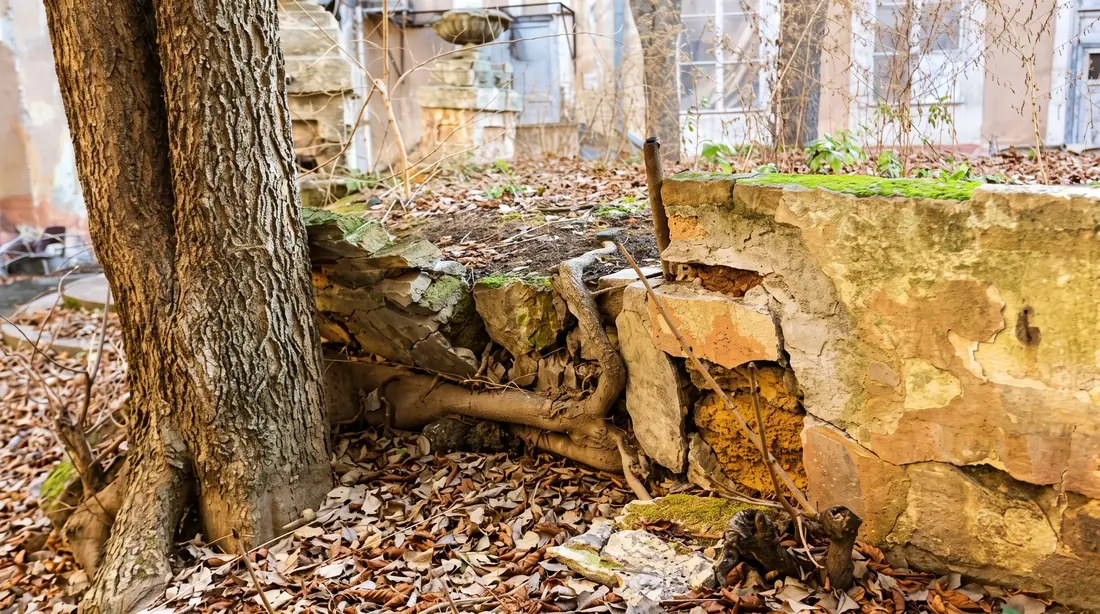
A tree's roots spread out to find water and to anchor the tree. As a guide, roots reach roughly one and a half times the tree's mature height, or two to three times the width of its canopy. In the clay-heavy soils common across the MidCoast hinterland, big tree roots can dry the ground out over summer. This causes the soil to shrink and shift. Over time, that movement can crack foundations, warp floors, and lift driveways, paths, or low garden walls.
Mature Tree Height
Minimum Distance from House
Why
Under 8 m
At least 3 m
Roots are shallow and compact; low risk
8–15 m
At least 4–6 m
Wider root spread can shift clay soil under footings
Over 15 m
At least 10–15 m
Large lateral roots can crack foundations
These are minimum distances, not targets. Extra room reduces the risk further and gives the canopy space to develop properly.
5. Keeping Roots Away From Pipes, Septic Systems and Powerlines
Water and Sewer Pipes
Tree roots rarely break into a solid, intact pipe. The real risk is older pipes, especially clay ones, that already have a small crack or loose joint. Roots exploit that weak point. Over time, they slowly block or crack the pipe from within.
Compact-rooted natives such as Coastal Rosemary or dwarf Grevillea are safer choices near underground pipes. A physical root barrier adds extra protection for larger trees. Before you dig or plant near any line, a free Before You Dig Australia (BYDA) check will show you exactly where your pipes, cables, and gas lines run.
Septic Tanks and Land Application Areas
Keep all trees and large shrubs at least 10 metres from a septic tank or its land application area (the drainage field). Keep them at least 30 metres away for thirsty species like willows and poplars. Avoid vegetable gardens, herbs, or fruit trees within 5 metres of the drainage field. This is because it can let pathogens from treated wastewater into your food. Directly over the drainage field, stick to shallow-rooted turf, native groundcovers, or small, drought-tolerant shrubs.
Powerlines
Essential Energy sets clear rules for planting nearby. Keep large trees at least 15 metres from overhead powerlines, or as far as the tree's mature height, whichever is greater. Stay 3 metres clear of poles. Keep canopies 2 metres clear of low-voltage service lines. If a tree is already growing too close to a line, do not prune it yourself. Contact Essential Energy or a qualified arborist instead. If storm damage brings a tree down onto a powerline, stay at least 8 metres back and call emergency services straight away.
Already have a tree that needs regular trimming to stay clear of a line? Get in touch for a straightforward quote on tree pruning pricing or arborist prices, no surprises.
6. Trees to Avoid Near Your House
Some trees, native and introduced, cause enough trouble that they are best avoided close to a house altogether.
Trees With Aggressive Roots
Weeping Willow (Salix babylonica) and Lombardy Poplar (Populus nigra): fast-growing, thirsty roots that can travel more than 30 metres in search of water. Keep them well away from pipes and foundations, or avoid them on a residential block altogether.
Weeping Fig and Moreton Bay Fig (Ficus species): large, shallow root plates that can crack concrete slabs, lift driveways, and block sewer lines.
Eucalypts (gum trees): valuable habitat trees and lovely to have on a bigger block. But their wide root systems and habit of dropping limbs in storms mean they belong at least 15 metres from the house.
Already have one of these too close to the house? Get it assessed. Options range from careful pruning to full tree removal, and sometimes relocating a mature tree is possible too — our tree transplanting service can tell you if that's an option for your tree. An on-site quote will give you realistic tree cutting services prices for your situation.
Environmental Weeds (Safe to Remove, Not to Plant)
These species spread from gardens into surrounding bushland. They crowd out native plants. MidCoast Council lists them as exempt species, meaning you generally do not need a permit to remove them:
Camphor Laurel (Cinnamomum camphora): fast-growing and highly invasive, with roots known to damage sewer and water pipes.
Privet (Ligustrum lucidum and L. sinense): forms dense thickets that crowd out native plants underneath, and its pollen can trigger allergies.
Cocos Palm (Syagrus romanzoffiana): its seeds spread easily via birds, and it can be toxic to flying foxes and bats.
Coral Tree (Erythrina x sykesii): brittle branches that can drop without warning, a real safety risk near a house or driveway.
Radiata Pine (Pinus radiata): acidifies the soil around it and builds up a heavy load of dry needles, adding to fire risk.
Removing one of these is generally good for your garden and the local bush. Most exempt species do not need a permit, but it pays to check first.
We can handle removal and stump grinding in the same visit as trusted local stump removalists, including a palm removal cost quote if a Cocos Palm needs to go.
7. Do You Need Council Approval Before You Plant?
Good news: planting a tree does not usually need council approval. The rules mostly kick in later, if you ever want to prune or remove it once established. Under MidCoast Council's Vegetation Management Policy, a tree becomes “protected” once it reaches 5 metres tall, or its trunk measures more than 600 mm around (roughly 60 cm), measured at 1 metre above ground. Once your tree reaches that size, you will need council consent to prune or remove it later, unless it qualifies for an exemption.
One exemption worth knowing now: trees within 3 metres of your house wall can generally be removed without consent down the track. The exception is if they turn out to be a registered significant tree or a koala food tree in the Hawks Nest or Tea Gardens area. Planning to plant a koala food species such as Swamp Mahogany, Forest Red Gum, Tallowwood, or Scribbly Gum? They are great for local wildlife. But they pick up extra protection once established, particularly around Hawks Nest, Tea Gardens, and Smiths Lake.
See our council permit page for the full process, exemptions, and fees. It's worth a read before you plant anything you might want to change your mind about later.
GOT A TREE THAT NEEDS ATTENTION? WE CAN HELP
Getting the right tree in the right spot now saves you money and hassle later. Maybe you already have an established tree that has outgrown its spot. Maybe it's showing storm damage, or causing concerns near your house, pipes, or powerlines. If you've been searching for an arborist near me, MidCoast Tree Solutions is based right here on the MidCoast and can get someone out to take a look. Either way, our team can assess it on site and recommend the right next step.
Our team holds AQF Level 5 arborist qualifications. If you already have an established tree that needs a health check, pruning, or removal, we can quote on that too. This ranges from arborist prices for a single tree through to full tree cutting services prices for larger jobs, or our land clearing services if you're starting a whole block from scratch.
We work across the entire MidCoast region, from Forster and Tuncurry to Taree, Wingham, Old Bar, and everywhere in between.