Common Tree Diseases and Pests on the MidCoast (And What They Actually Look Like)
Most homeowners do not notice a tree is sick until it starts dropping branches or looks half dead. By then, the problem has often been building for months, sometimes years. The best way to catch it early is knowing what to look for.
The MidCoast's mild, humid climate is good for trees. It is also good for the fungi, insects, and other pests that attack them. Some problems are only cosmetic, nothing to worry about. Others can kill a mature tree, or turn it into a real safety risk, if you leave it alone.
This guide covers the diseases and pests we see most often on MidCoast properties. Our arborists at MidCoast Tree Solutions describe what they actually look like on your tree, not in technical jargon. We also explain when a pest or disease is not, by itself, a reason to remove a tree.
Key Takeaways
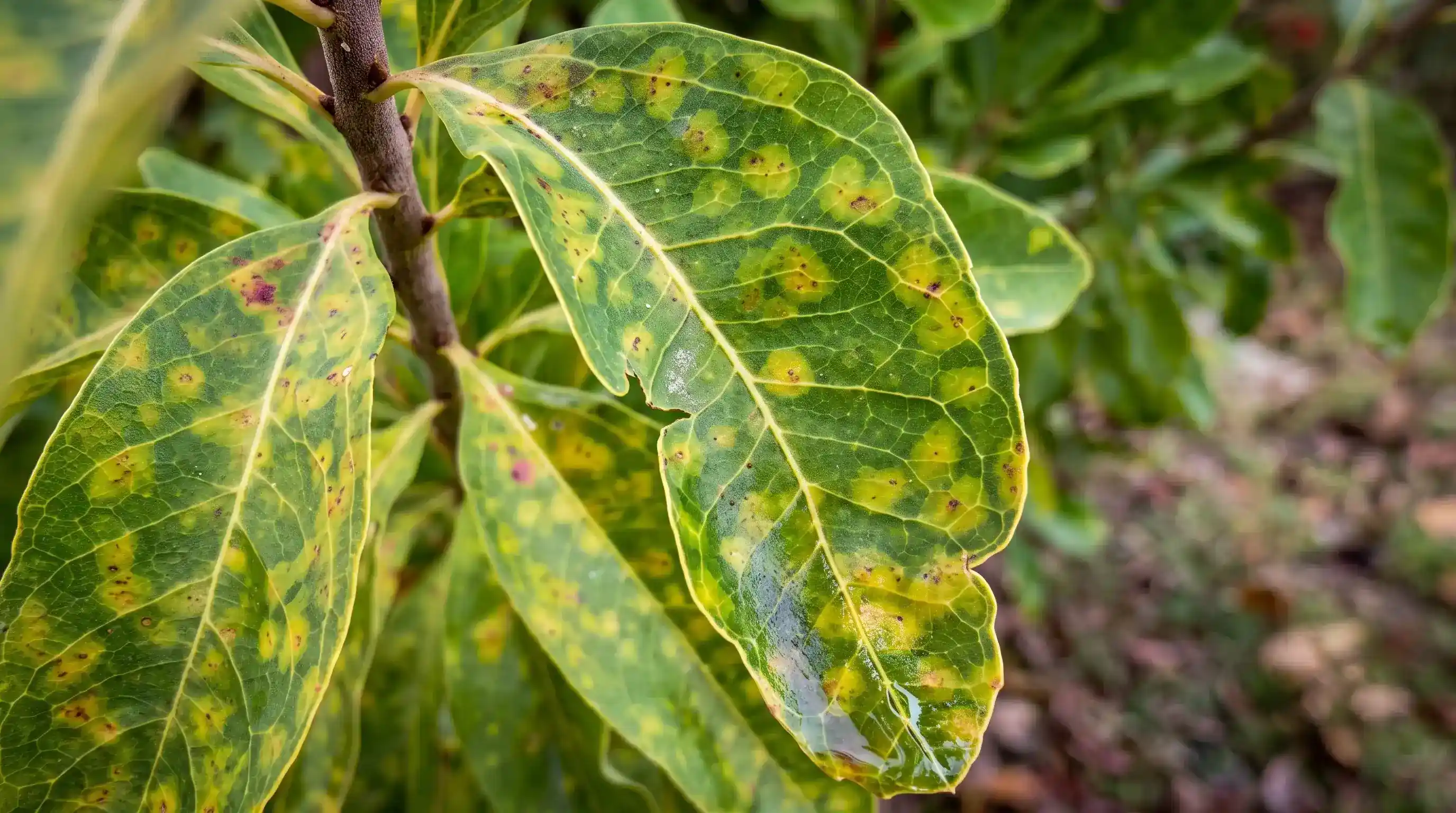
Myrtle Rust shows up as tiny purple spots that turn into bright yellow, powdery lumps. It only attacks plants in the Myrtaceae family (lilly pillies, bottlebrush, tea tree, eucalypts).
Cypress Canker causes reddish-brown branch dieback (“flagging”) and oozing resin on Leyland and Monterey Cypress. Prune into healthy wood and disinfect tools between cuts.
Phytophthora dieback attacks roots from wet soil and can look like drought stress. Wilting leaves that droop into a “shepherd's crook” shape are a telltale sign.
A thick, webbed mass of sawdust in a branch fork usually means Fruit Tree Borer, a native moth larva that tunnels into the sapwood.
Termites in a living tree are not automatically a reason to remove it. They mostly eat dead heartwood, and removing the tree without treating the colony can push them toward your house instead.
Leaf litter, minor pests, blocked gutters, and blocked views are not valid grounds for a council to remove a tree.
1. Myrtle Rust: The Disease Threatening MidCoast Natives
Myrtle Rust (Austropuccinia psidii) is a fungal disease. It only attacks plants in the Myrtaceae family — think lilly pillies, bottlebrush, tea tree, and eucalypts. It arrived in Australia in 2010 and has since spread up and down the NSW coast, including across the MidCoast.
It is easy to spot once you know the pattern. Within three to five days of infection, tiny purple-to-red spots appear on young leaves, shoots, or flowers. Within ten to twelve days, these turn into bright, powdery, golden-yellow lumps. Look closely and you can see they are made up of thousands of spores. As the infection ages, the lumps fade to dull yellow, then grey-brown. In bad cases, the spots merge together. Leaves curl and twist, and repeated infections stop new growth coming through, leaving branches with a scorched look.
Some MidCoast rainforest natives are hit especially hard. Native Guava and Scrub Turpentine are both very vulnerable. Field surveys have recorded population losses of 80 to 99 percent in Native Guava where the disease has taken hold.
The spores spread easily on wind, clothing, and equipment. If you spot the telltale yellow lumps on a lilly pilly or other native, avoid brushing against the plant. Consider reporting it to the NSW DPI Biosecurity line so the spread can be tracked.
2. Cypress Canker: What's Killing Your Ornamental Conifers
If you have a row of Leyland or Monterey Cypress as a windbreak or privacy screen, Cypress Canker is worth knowing about. It is a fungal disease (Seiridium species). It gets in through small wounds in the bark — from insects, birds, or even pruning cuts — and blocks the tree's internal water system.
The first sign is often subtle. The foliage loses its healthy gloss and turns a dull yellow. From there, whole branches turn reddish-brown and die, starting at the tips. Arborists call this pattern “flagging”, because it stands out so clearly against the green canopy. Look closer at the trunk or branches and you may find sunken, elongated cankers with a reddish-brown edge, sometimes weeping amber-to-white resin. Tiny black, pinhead-sized growths inside these cankers release the spores that spread the disease in rain and wind.
Monterey Cypress, Leyland Cypress, and other ornamental conifers are all vulnerable. Drought or high humidity makes things worse.
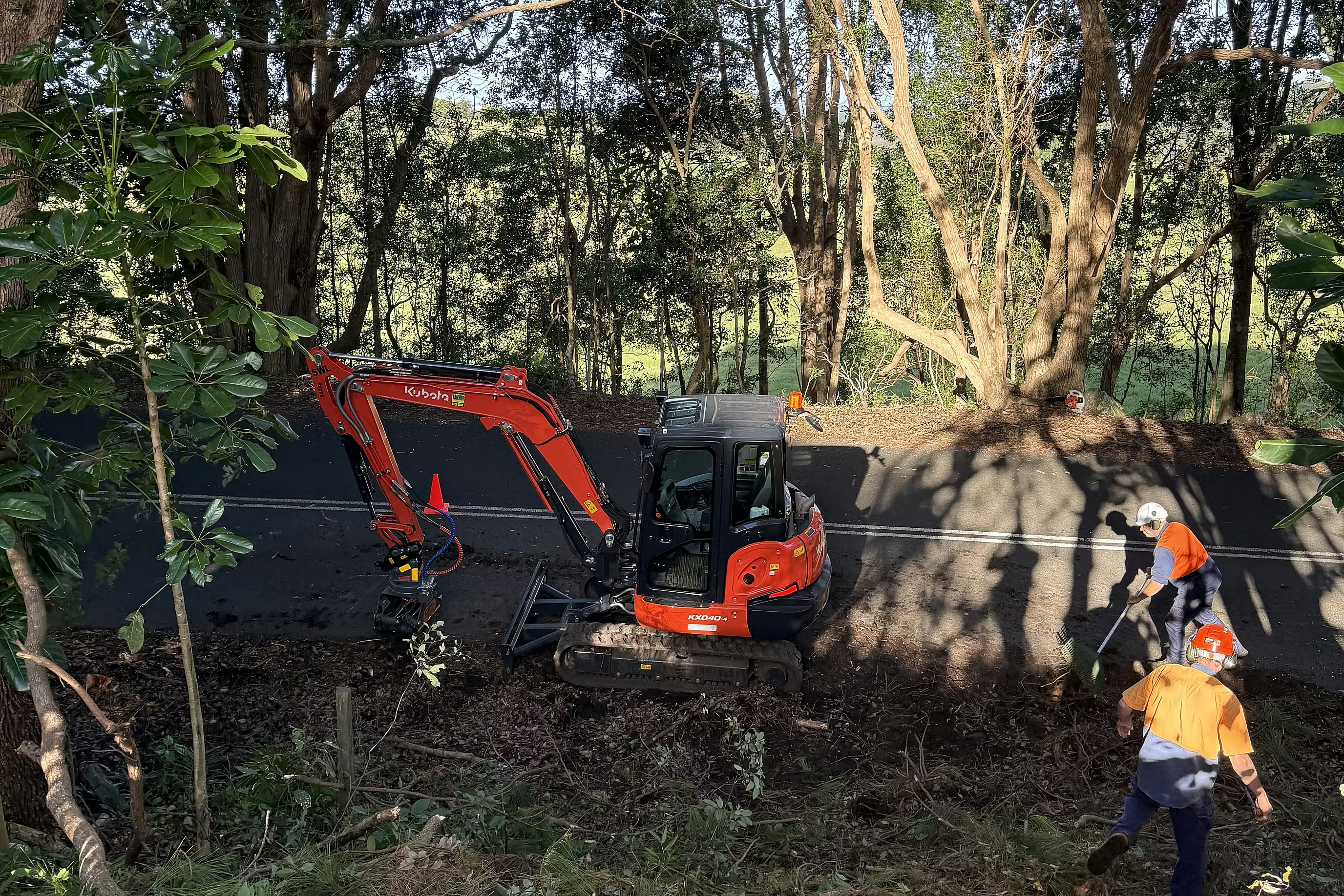
If you catch it early, cutting off infected branches well back into healthy wood can help. Just make sure your tools are disinfected between cuts, so you do not spread the disease yourself. Our tree pruning service can handle this kind of clean-up pruning safely. For advanced cases, our tree removal team can take the tree down cleanly to protect the trees next to it, right through to full tree trunk removal if that's what's needed.
3. Phytophthora Dieback: The Hidden Root Killer
Phytophthora cinnamomi lives in the soil and destroys root systems from below. This makes it tricky to diagnose. Above ground, the symptoms look a lot like drought stress. Leaves lose their firmness and droop downward in a pattern called “shepherd's crook” — the wilting branch curves over like a shepherd's staff, showing the pale undersides of the leaves. Yellowing usually starts at the branch tips and works inward. You will also see early leaf drop and a canopy that thins out.
The real damage is underground. Dig around the base and you may find small roots with dark brown to black patches of dead tissue. The outer layer often slides off easily when you pull on it, leaving a thin, thread-like core behind. In severe cases, dark, water-soaked patches spread from the roots up into the lower trunk.
This pathogen thrives in wet, poorly drained soil. Its spores can survive in dry soil for years. Once conditions turn damp, they become active and swim through wet soil to find new roots. On rural blocks, watch out for feral pigs too — their rooting and wallowing damages roots, and their hooves can carry the pathogen between properties.
If a tree is confirmed to have Phytophthora, how it is removed matters. Standard removal methods can spread the pathogen further through your garden. The safer approach: wait until the tree is completely dead and the soil has dried out, cut the trunk low instead of digging out the stump, and disinfect tools, boots, and vehicle tyres before leaving the site. This is exactly the kind of job worth getting a professional to look at first. Request a free quote and we can assess it properly.
4. Plane Anthracnose: Common on Street and Shade Trees
London Plane trees are widely planted as shade trees across the MidCoast. Plane Anthracnose is one of the most common problems they face. In early spring, look for dark brown, blotchy patches running along the veins of new leaves. Affected leaves shrivel and drop early, leaving a noticeably bare canopy. Small twigs can also develop cankers that ring right around the stem, creating a tangled, “witches' broom” branching pattern where new growth clusters awkwardly.
The fungus spreads through rain splash and wind, especially in wet weather, so good clean-up makes a real difference. Rake up fallen leaves and pruned twigs and put them in the bin, not the compost. Disinfect pruning tools between cuts so you do not carry spores to the next tree.
5. Wood-Boring Pests: The Fruit Tree Borer
The Fruit Tree Borer (Maroga melanostigma) is a native moth. Do not let that fool you — its larvae cause serious damage. Despite the name, it does not just target fruit trees. Stone fruit, plane trees, maples, birches, wattles, and increasingly elms are all on the menu.
The giveaway is a thick, webbed mass of sawdust and chewed wood, clustered where branches meet the trunk or along major limbs. Early on, it looks like rough, woven boot-lace debris. Later, it thickens into a silk-covered mat that shelters the caterpillar underneath. The caterpillar itself is cream-coloured with a dark brown head.
Underneath that webbing, the caterpillar feeds through the bark and tunnels into the sapwood, sometimes for up to two years. This can ring right around a branch. In young trees, that can kill off the main leader branch. In older trees, it can cause a branch to suddenly fail.
Because the larvae tunnel deep inside the branch, common backyard treatments do not reach them. This is a job for a professional with the right tools. If you spot the tell-tale webbed sawdust on a tree, get in touch and we can take a look before the damage spreads further.
6. Sap-Sucking Pests to Watch For
A handful of sap-sucking insects turn up again and again on MidCoast properties. None of them bore into the wood, but a heavy infestation can drain a tree's energy and leave it looking sick and sorry for itself.
Pest
What It Looks Like
Trees It Targets
Sycamore Lace Bug
White speckling on leaves that turns to bronzing; undersides fouled with black, tar-like spots
London Plane trees
Giant Willow Aphid
Large brown aphids with a thorn-like bump on their back; leaves and stems coated in sticky honeydew and black sooty mould
Willows, poplars, occasionally apples
Moreton Bay Fig Psyllid
Sticky residue and heavy leaf drop from small sap-sucking nymphs
Moreton Bay Fig and Port Jackson Fig
Olive Lace Bug
Pinhead-sized yellow spots on leaves; heavy infestations cause full defoliation
Native and European olive trees
Brown Lace Lerp Psyllid
Small white “lerp” shells on leaf undersides, followed by yellowing and dieback
Eucalypts, especially E. grandis and E. saligna
Fruit Spotting Bug
Sunken, crater-like marks on fruit and flowers
Macadamia, stone fruit, native rainforest plants
Most of these pests are more of a nuisance than a killer. A healthy, well-watered tree usually shrugs off a moderate infestation. But if honeydew, sooty mould, or leaf loss keeps getting worse each year, it is worth having the tree checked. Ongoing stress from sap-suckers can make a tree more likely to catch the diseases covered above.
7. Termites in Standing Trees
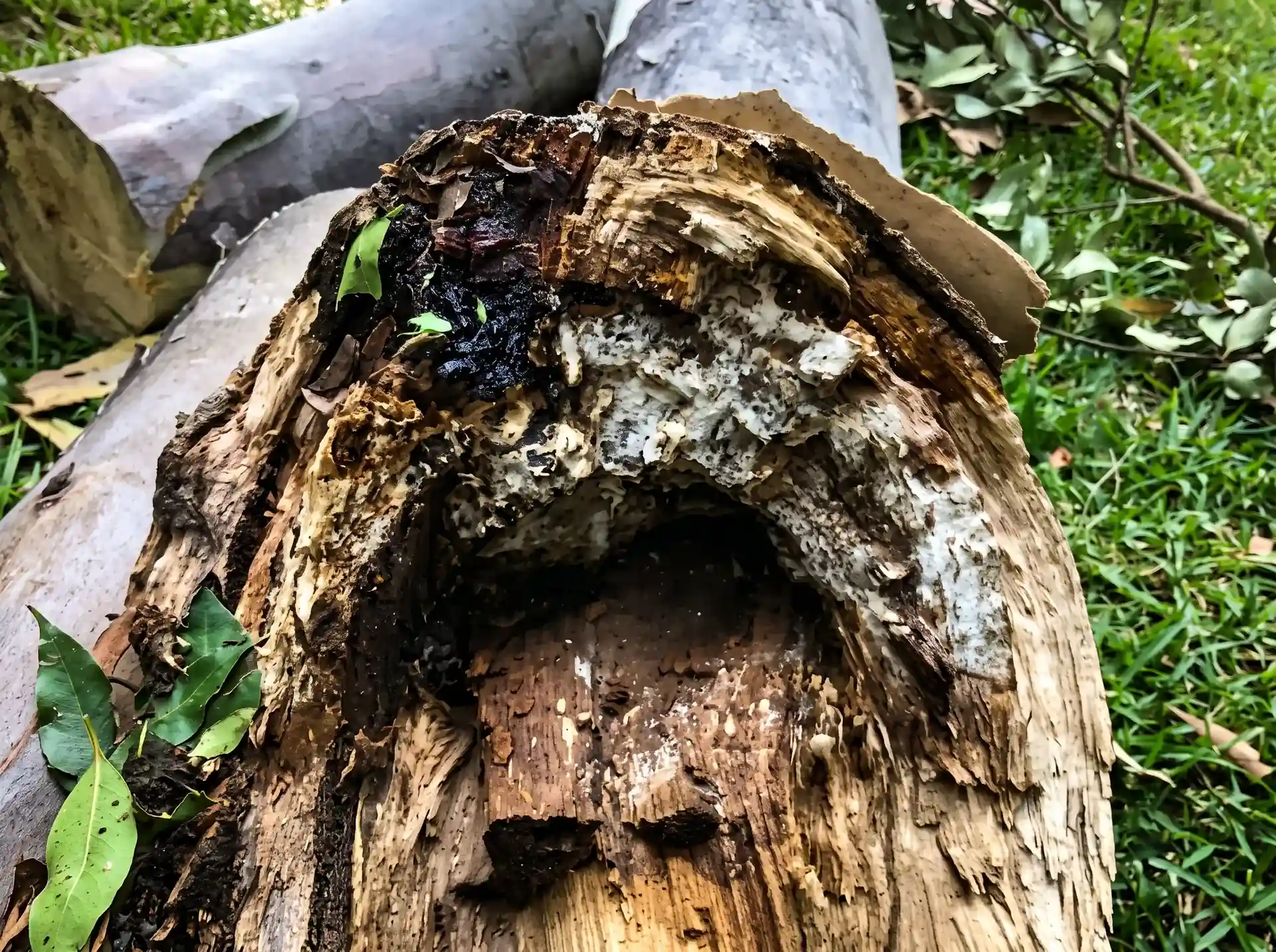
Large, mature eucalypts — Coastal Blackbutt and Spotted Gum especially — often host termite colonies on MidCoast properties. That does not automatically mean the tree is dying or dangerous. Termites feed mainly on dead heartwood in the centre of the trunk. The living sapwood around the outside keeps working normally.
Mud shelter tubes: thick, brown, mud-like tunnels running up the outside of the bark.
Arboreal nests: large, rounded mud structures built high in the trunk or branch forks.
Shed wings: small piles of see-through wings around the base of the trunk after a mating flight.
Mud-plugged holes: small slits or holes in the bark packed with fresh mud.
A hollow sound when you tap the trunk, or sap oozing from an unexpected spot.
Some species nest entirely inside the heartwood, with no outward signs at all. That is why a proper inspection sometimes needs a small test hole and a tiny camera, not just a look from the ground.
On public land, MidCoast Council does not automatically remove a tree just because it has termites. Under the Tree Management on Council Managed Land Policy, an infested tree can stay standing — and keep providing habitat for possums, gliders, and birds — unless a qualified arborist finds it is no longer structurally sound. The same logic applies to your own property. Removing a termite-affected tree without dealing with the colony can just push the termites toward your house, looking for a new food source.
If you are concerned about a tree on your own block, get a proper termite and timber pest inspection. Australian Standard AS 3660.2 recommends one every 6 to 12 months. It will tell you whether the tree is a genuine risk, or just an old tree doing what old trees do. The team at MidCoast Tree Solutions can carry out this kind of inspection, and if removal turns out to be the right call, our tree removal team can take care of it safely.
8. When Pests or Disease Aren't Grounds for Removal
Spotting a problem on a tree does not automatically mean it has to come down. If the tree is on council land, MidCoast Council is quite clear about what does and does not justify removal. None of the following count as valid grounds on their own:
Normal leaf, twig, or fruit drop, even if it blocks gutters or stormwater drains.
Native wildlife activity, like bird or bat droppings, noise, or nesting.
Aesthetic complaints, or wanting to improve a view.
Shade falling on solar panels, pool heating, or the garden.
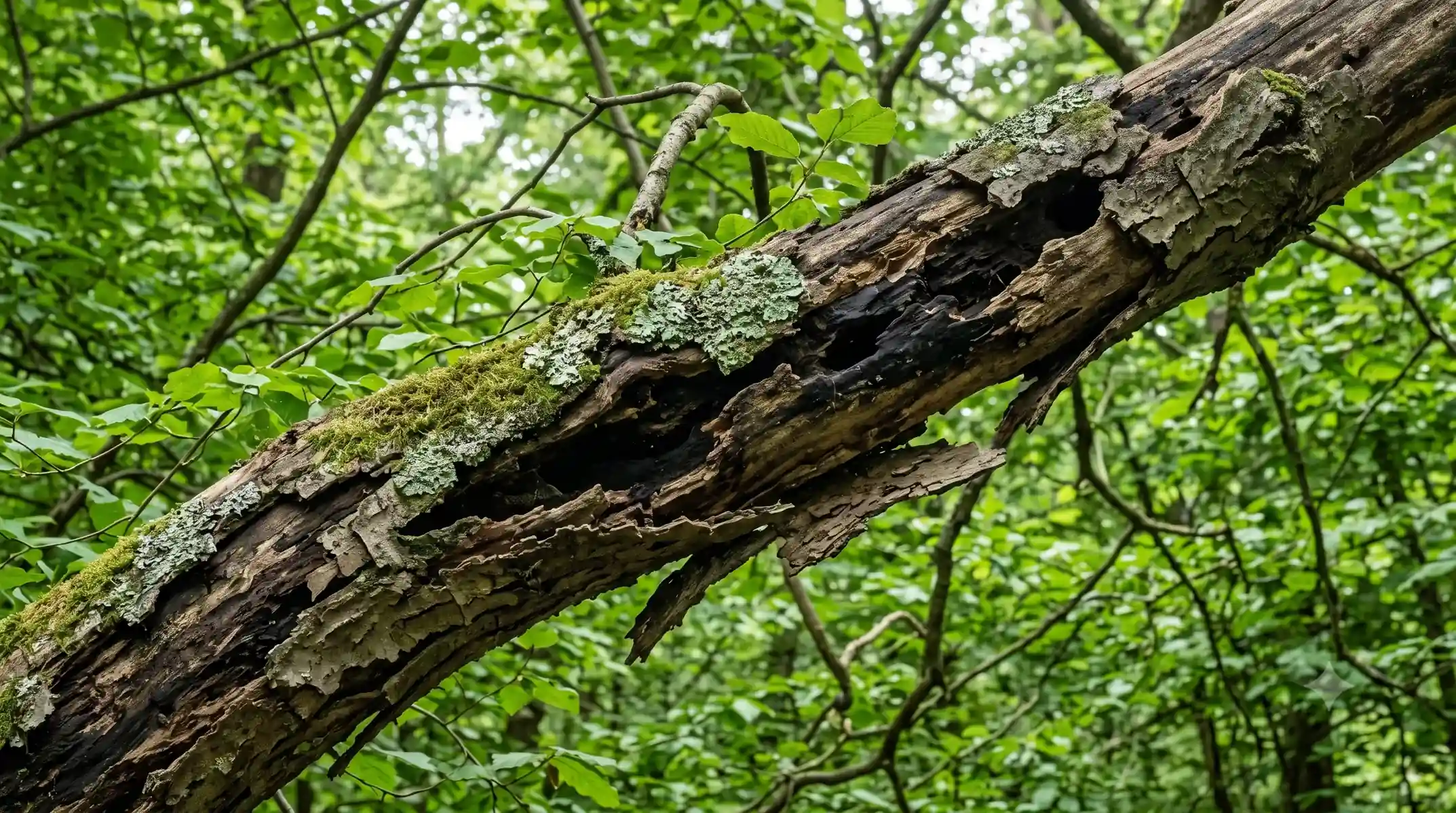
Minor pest or disease presence that isn't affecting the tree's structural integrity.
Slippery paths caused by moss or damp shade.
Where a tree genuinely is a hazard, council uses a risk-based system to decide how urgently it needs attention:
Risk Level
What It Looks Like
Action Timeframe
Extreme
Trunk or major limbs at imminent risk of failure
Within 7 days
High
Severe decay, cracking, or significant dieback
Within 6 weeks
Moderate
Defects present but currently manageable
Within 12 months
Low
Minor, cosmetic issues only
Monitored, no set action
The same logic applies to your own trees. A bit of sooty mould or a few lerps on the leaves is not usually an emergency. But genuine structural decay — especially combined with a lean, cracking, or dieback — is worth getting checked properly. If you are not sure which category your tree falls into, request a free quote. That is exactly what an arborist assessment is for.
NOT SURE WHAT'S WRONG WITH YOUR TREE? WE CAN HELP
Spotting a problem early is the best way to save a tree — or to know for sure when it is time to let it go. If you've been searching for an arborist near me, MidCoast Tree Solutions can inspect a tree showing signs of disease, pest damage, or termite activity, and give you a clear recommendation. That might be clean-up pruning, monitoring, or full removal.
Our team holds AQF Level 5 arborist qualifications. If a tree does need to come down, we can quote on that too — from arborist prices for a single tree, through to full tree cutting services prices for larger jobs, including commercial stump grinding for bigger sites.
We work across the entire MidCoast region, from Forster and Tuncurry to Taree, Wingham, Old Bar, and everywhere in between.