Are Tree Roots a Threat to Your Foundations, Pipes, or Pool?
A crack in the driveway or a slow drain doesn't automatically mean a nearby tree is to blame, soil type and pipe condition usually matter more than the tree itself. Here's how to tell what's actually causing the damage, and what MidCoast Council and the law expect before you reach for a chainsaw.
A crack creeping across the garage slab, a drain that keeps backing up, or a pool deck that's started to lift — it's easy to look at the big tree nearby and assume the roots are to blame. Sometimes they are. Just as often, the real cause is the soil underneath your house, an ageing pipe joint, or a slab that was never quite level to begin with, and the tree is simply the easiest thing to point at.
Getting this right matters. Removing a healthy, well-placed tree over a problem it didn't cause costs you shade, kerb appeal, and possibly a council fine, while ignoring a genuine root conflict near your footings or pool can turn into an expensive repair bill.
This guide walks through how tree roots actually damage foundations, pipes, and pools, what MidCoast Council and NSW law expect from you, and how to work out what's really going on before you decide anything.
Key Takeaways
Roots rarely crack solid concrete footings by brute force, on clay soils, the more common cause is the tree drying out the ground underneath, causing the slab to settle unevenly.
Tree roots can't force their way into an intact pipe, they exploit joints, cracks, or gaps that are already there, often in ageing clay or concrete lines.
Modern PVC and HDPE pipes, properly installed, are far more root-resistant than older clay or concrete pipe joints.
Around pools, the bigger risk is usually from large shallow roots pushing up against coping and pavers, or soil beneath the shell drying out unevenly.
A geotechnical or structural engineer's report, a plumber's CCTV inspection, or a pool inspection will confirm the actual cause, an arborist's report covers the tree side of that picture.
MidCoast Council still requires a permit or a self-assessed exemption for tree work in mapped zones, even when the tree is causing damage.
If the tree is on a neighbour's property, minor cracking or normal maintenance issues generally won't meet the legal bar for a forced removal order.
1. How Tree Roots Actually Affect Foundations
The idea that a growing root physically lifts and cracks a concrete slab is the most common myth in this whole topic. Mature tree roots rarely have the raw mechanical force to shear through a properly engineered, reinforced concrete footing or pier. It can happen to thin, unreinforced garden paths or light garden walls, but a modern house slab is a different story.
The real mechanism on much of the MidCoast's clay soil is moisture, not muscle. Trees pull large volumes of water out of the soil through their roots to keep their leaves going. When those roots spread in under a house footing, they draw moisture out of the clay directly beneath it. In a dry spell, that patch of soil shrinks, and the footing above it can settle unevenly, sometimes called "dishing." Pull the tree out entirely and the opposite can happen, the ground rehydrates and swells back up, which can also move a footing.
Why Soil Type Matters More Than the Tree
Australian homes are built to a standard called AS 2870, which grades sites by how much the soil is expected to swell and shrink with the seasons. Sand and rock sites move very little regardless of what's planted nearby. Reactive clay sites, common across parts of the Manning Valley, move a lot more, and the more reactive the clay, the further away a thirsty, high-water-use tree needs to be kept from the footings, roughly in proportion to how tall the tree will grow.
Site Class
What It Means
Tree-Related Risk
Class A / S
Sand, rock, or slightly reactive soil
Low, moisture swings are minor regardless of nearby trees
Class M
Moderately reactive clay
Moderate, larger trees need reasonable separation
Class H1 / H2
Highly reactive clay
Higher, thirsty trees close to footings are a real factor
Class E
Extremely reactive clay
High, professional advice on tree placement matters
Class P
Problem site (fill, slope, or existing trees)
Requires individual engineering
Source: AS 2870-2011/2017 Residential Slabs and Footings; general geotechnical guidance for reactive clay sites
Signs Worth Getting Checked
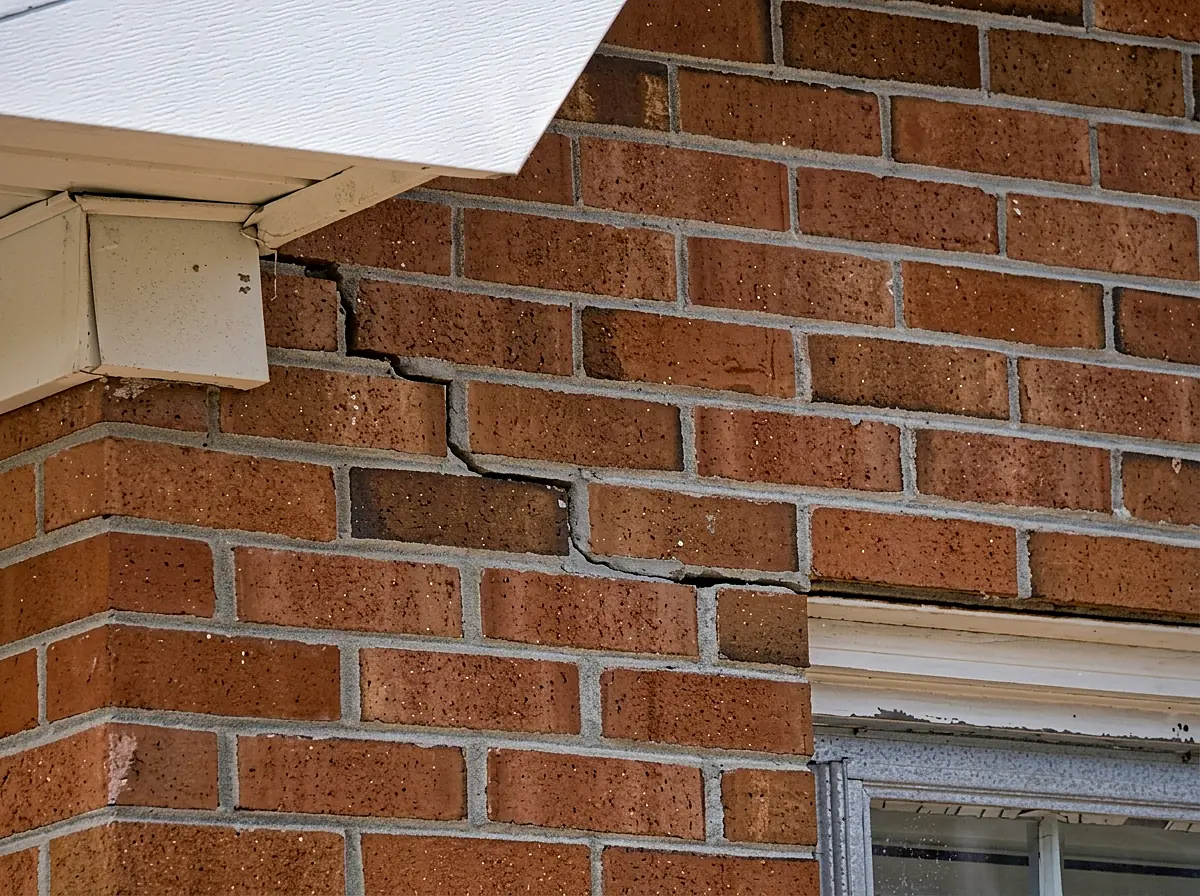
A few hairline cracks under a millimetre wide in plaster or mortar are considered normal seasonal movement, not a structural problem. What's worth a proper look is cracking wider than about 5 mm, especially stepped diagonal cracks running from the corners of windows and doors, doors and windows that have started sticking, or gaps opening up between skirting boards and the floor. These patterns point to genuine differential settlement, and a geotechnical or structural engineer, not a tree removal, is the right first call to confirm the cause.
2. Do Roots Really Damage Underground Pipes?
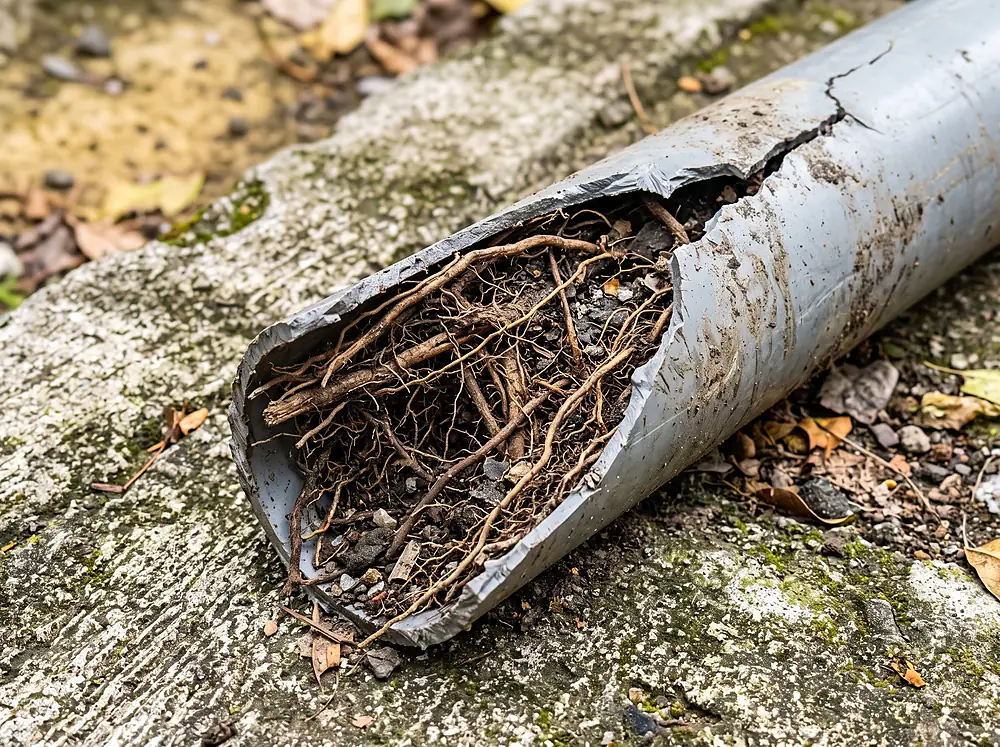
Old clay or concrete sewer and stormwater pipes get a lot of blame for tree root blockages, and the pipes themselves are usually already part of the problem. Roots do not have the strength to punch through an intact pipe wall. What actually happens is called hydrotropism, roots grow toward moisture, and a leaking joint or hairline crack in an old pipe releases exactly that kind of moisture and nutrient plume into the surrounding soil.
Once a root tip finds that leak, often through a gap as small as half a millimetre, it grows inside and branches out into a dense mat that catches debris and blocks the flow. Older pipe networks around Taree and Forster, often short lengths of clay or concrete joined with seals that degrade over time, are the ones most exposed to this. Modern PVC and HDPE pipes, installed with proper rubber-ring or welded joints, are much more resistant, since there are far fewer gaps for a root to exploit in the first place, unless the pipe itself gets cracked by ground movement or poor bedding.
If you've got recurring drain blockages or slow-draining fixtures, a licensed plumber running a CCTV camera through the line is the only reliable way to confirm whether roots are involved and exactly where the pipe has failed. If they are, the two common fixes are traditional excavation and pipe replacement, or trenchless relining, where a new lining is set inside the existing pipe without digging up the garden. Either way, that's a plumbing decision, an arborist's role is to assess whether the tree is a genuine ongoing risk to the repaired line and what, if anything, needs to happen with the tree itself.
3. Are Swimming Pools at Risk?
Pools face a different kind of pressure. Large, shallow, fast-spreading roots, the kind produced by species like Moreton Bay Figs or Camphor Laurels, can push directly against pool coping and surrounding pavers as they thicken over the years. That lifts and cracks the surrounding concrete, which then throws off the drainage slope and can direct runoff straight back toward the pool shell instead of away from it. Camphor Laurel is also a priority weed under the Biosecurity Act 2015 and is actively being targeted for control in parts of the MidCoast, including Forster and Gloucester, so removing one near a pool can tick two boxes at once.
Source: NSW WeedWise, Camphor laurel (Cinnamomum camphora); MidCoast Council priority weed control program
The other pathway is the same moisture story as foundations. Roots growing near or under a pool shell can dry out the supporting clay unevenly, leading to uneven settlement and stress cracks in the shell. If the pool is drained for maintenance while the surrounding clay is dried out, heavy rain afterwards can cause that same soil to swell unevenly and push up against the shell from underneath. Buried pool plumbing, the flexible pipes running to the skimmer box and main drain, can also shift and leak if root growth moves the soil around them.
If a tree is otherwise healthy and simply planted too close to a pool or a new extension, transplanting it to a better-suited spot on the property is worth exploring before committing to removal.
4. What MidCoast Council Requires Before You Act
Even when a tree is genuinely causing damage, you can't necessarily just remove it or start cutting roots. MidCoast Council's Vegetation Management Policy applies to mapped zones where native canopy supports habitat corridors, urban greenery, or threatened species, rather than blanket rules across the whole LGA, so the first step is always checking whether your property falls inside one of those zones.
If your property is outside a mapped zone, pruning or removal can generally go ahead without a council permit, provided no other state legislation applies.
If it's inside a mapped zone, check the self-assessment criteria, dead trees, immediate safety risks, and some invasive species may qualify for an exemption rather than a full permit.
If no exemption applies, a formal permit application is required, and where you're claiming the tree is damaging your home, pipes, or pool, council expects supporting documentation, a structural or geotechnical engineer's report for footing or pool damage, a licensed plumber's CCTV report for pipes, and an AQF Level 5 arborist's assessment of the tree itself.
As at the time of writing, the standard council inspection fee is $260, with assessment taking up to 28 days, and permits or exemptions are valid for 12 months. If you're using a self-assessed exemption, the certificate needs to be displayed at your front boundary for two days before and two days after the work. Confirm current fees and timeframes with council before you apply, as they're reviewed each financial year. Our council permit guide walks through the full process. Unauthorised work on protected vegetation is a genuine offence under the Environmental Planning and Assessment Act 1979. As at the time of writing, on-the-spot penalties sit at $3,000 for an individual and $6,000 for a company, and matters prosecuted through the Land and Environment Court can attract fines well into six figures, so it's worth getting the paperwork right before starting any tree work. Council fees and penalties are reviewed each financial year, so confirm current figures with council directly.
Properties on bushfire-prone land may also be able to clear vegetation near buildings without a council permit under the NSW Rural Fire Service's 10/50 Vegetation Clearing Code or the Rural Boundary Clearing Code, which is worth checking if your situation also involves defensible space around the house.
When the tree causing the damage is next door, not on your own land, the process runs through the Trees (Disputes Between Neighbours) Act 2006 (NSW), and any formal application goes to the NSW Land and Environment Court.
The onus is on you, as the applicant, to show the tree has caused, is causing, or is genuinely likely to cause damage in the near future, generally read as within about the next 12 months. Courts also apply a fairly consistent "urban living tolerance" standard, minor leaf litter, seasonal debris, or small cosmetic cracks in a garden path are treated as ordinary maintenance that comes with living near trees, not grounds for a removal order. That principle was set out clearly in Barker v Kyriakides [2007] NSWLEC 292, where the Court found that people living in urban areas need to accept a reasonable amount of garden and gutter maintenance as part of enjoying the benefits of nearby trees.
Where a pipe has actually been damaged, courts also tend to recognise that buried pipes have a finite service life of their own, so cost apportionment between the two property owners is common rather than the tree owner automatically wearing the full repair bill. Notifying your neighbour in writing as soon as you notice the damage also matters, delaying that notice can weaken a later claim for full compensation.
This section explains how the law generally works in NSW and is not legal advice. For anything beyond an initial conversation with a neighbour, it's worth getting advice from a solicitor.
Source: Trees (Disputes Between Neighbours) Act 2006 (NSW); Barker v Kyriakides [2007] NSWLEC 292
6. How to Actually Work Out What's Going On
Because roots, soil, and ageing infrastructure all overlap, working out what's really responsible for the damage usually takes more than one professional, not just a tree removal.
Suspected Problem
Who to Call First
What They Check
Cracked or settling slab
Geotechnical or structural engineer
Soil reactivity, footing movement, whether desiccation is the cause
Blocked or slow drains
Licensed plumber
CCTV inspection to find the exact defect and confirm root entry
Cracked pool coping or shell
Pool builder or structural engineer
Pressure testing pipework, deflection in the shell
Whether a specific tree is the risk
AQF Level 5 consulting arborist
Root spread, species water demand, safe retention or removal options
7. What to Do Next
Don't assume the nearest tree is guilty, get the underlying problem (soil, pipe, or pool structure) properly diagnosed first.
Check whether your property sits inside a MidCoast Council mapped vegetation zone before any tree work goes ahead.
If a permit is likely needed, start gathering the supporting reports, engineer, plumber, or arborist, early, since assessment can take up to 28 days.
If the tree is a neighbour's, put your concerns in writing as soon as you notice damage, and keep a copy.
Get an AQF Level 5 arborist's opinion on the tree itself before deciding between removal, root management, or leaving it alone.
If you'd like a professional opinion on whether a tree is actually behind the damage you're seeing, request a free quote and we'll come and take a proper look.
NOT SURE IF A TREE IS BEHIND THE DAMAGE? WE CAN HELP.
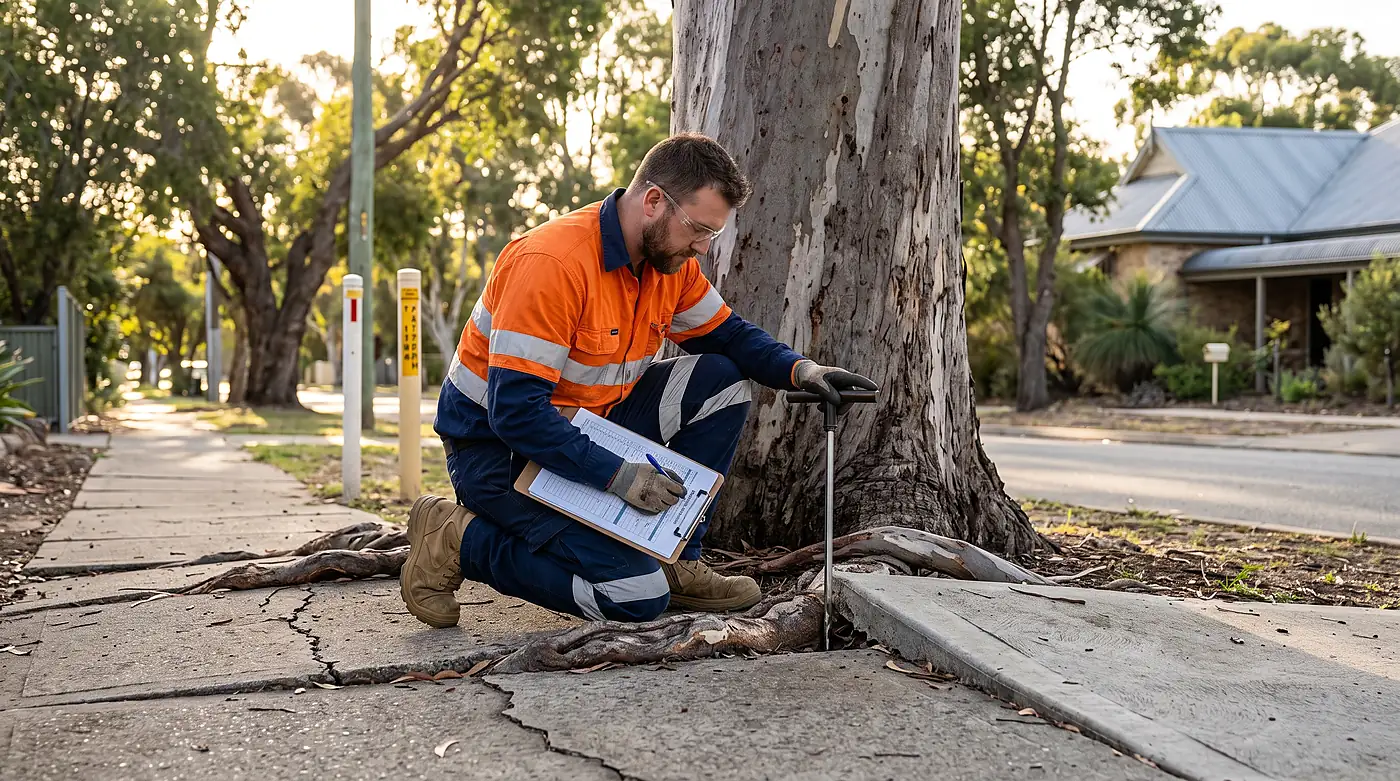
Our AQF Level 5 Consulting Arborists can assess a tree on site and give you a clear, documented opinion on whether its roots are genuinely contributing to damage on your property, the kind of independent report that also carries weight with council, an engineer, or in a neighbour dispute.
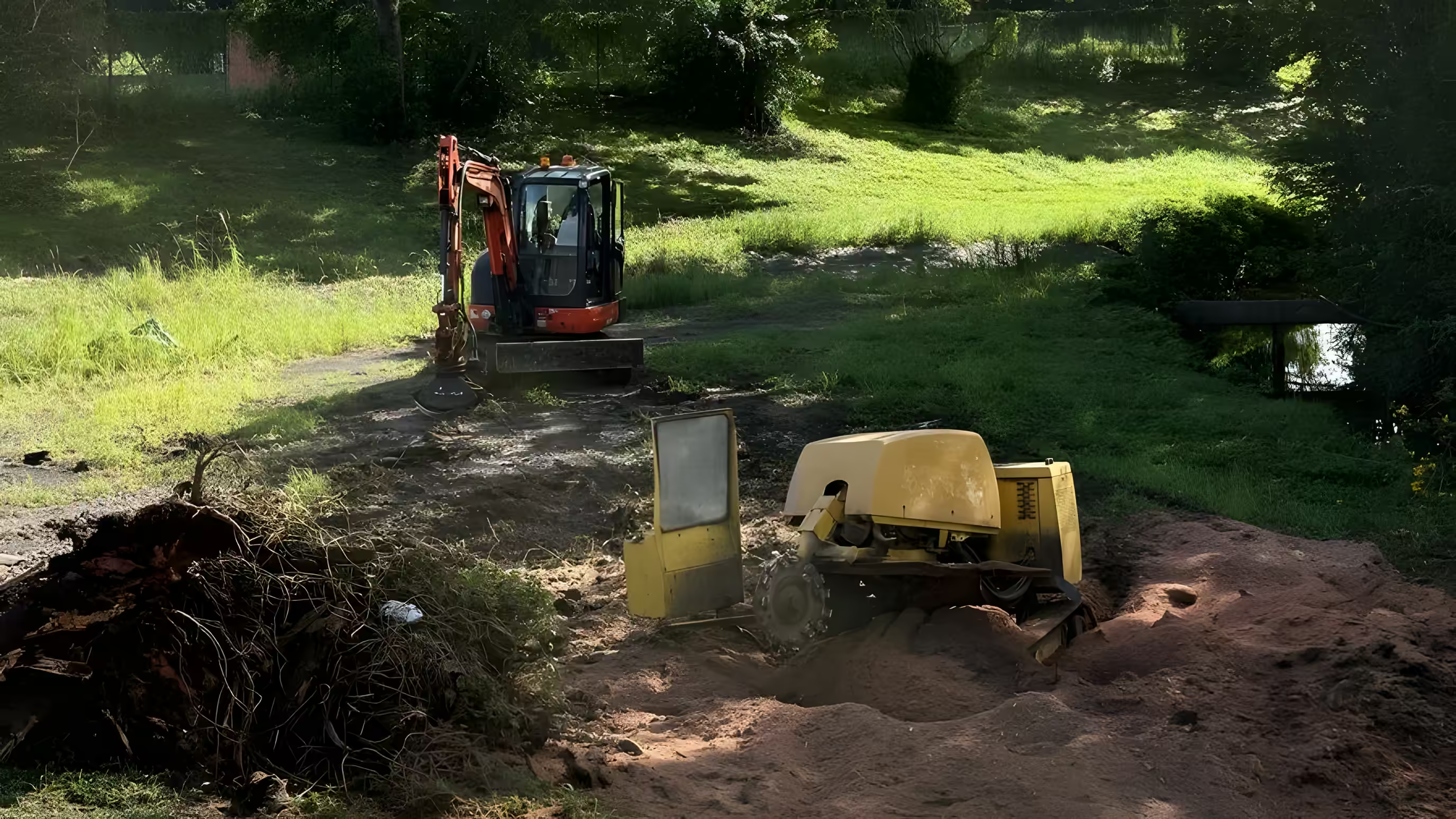
We are MidCoast Council panel providers and Arboriculture Australia members. If removal is the right call, our tree removal team can quote on that and include stump grinding in the same visit. If a tree is healthy but simply badly placed, our tree transplanting team can look at relocating it instead.
We work across the entire MidCoast region, from Forster and Tuncurry to Taree, Wingham, Old Bar, and everywhere in between.