Termites in Trees: Can a Tree Near Your House Put Your Home at Risk?
A termite nest in a big gum near the house is worth taking seriously, but cutting the tree down straight away is often the wrong first move. Here is how termites in trees reach homes, how to check the tree is still safe, and the order to deal with it in.
You notice a mud tube running up the trunk of the big gum by the driveway. Or a pest inspector taps the tree, hears a hollow thud, and tells you there is a nest inside. The first thought for most people is simple: if the termites are in the tree, how long until they are in the house?
It is a fair question. Large native trees are one of the main places termites live on the MidCoast, and a couple of the species that nest in them are known to cause serious damage to buildings.
But finding a termite nest in a tree does not always mean the tree has to go. Removing it in a hurry can leave you with a hidden colony, a damaged stump, and no clear answer about your house.
This guide explains how termites end up living in trees, how far they can travel to reach a building, how to tell whether the tree itself is still safe, and what to do first. It sticks to termites. For other pests and diseases, see our guide to common tree diseases and pests on the MidCoast.
Key Takeaways
Termites in a living tree mostly eat the dead heartwood in the centre of the trunk. The outer sapwood keeps working, so a tree can look green and healthy while it is hollow inside.
The species that matters most is Coptotermes acinaciformis, which the Australian Museum describes as the most destructive termite in Australia. It often nests inside living eucalypts.
Subterranean termites can forage around 50 metres from their nest, so a tree well away from the house can still be the source of a problem.
Deal with the colony before you cut. Felling the tree does not necessarily kill the colony, and a nest inside a standing trunk is often easier to treat.
A hollowed trunk is a separate safety question. An AQF Level 5 arborist can assess how much sound wood is left and whether the tree can stay.
Many home insurance policies exclude termite damage, so regular inspections are your main protection.
A hollow trunk can also be home to wildlife, so check for nests and animals before any pruning or removal.
1. How Termites End Up Living in Trees
A living tree is made of two kinds of wood. The outer sapwood carries water and nutrients and is alive. The heartwood in the centre is older, dead wood that mostly gives the tree its strength. Living sapwood is highly resistant to decay, so termites and fungi work on the heartwood instead.
Subterranean termites usually get in through the roots or the base of the trunk, often where there is an old wound, fire scar, or decay. Once inside, they eat out the centre of the trunk and fill parts of the cavity with a mix of chewed wood and soil. This is often called "piping".
Because the sapwood and bark are still working, the canopy can stay full and green for years. That is why many homeowners only find out about a nest during a pest inspection, or when a branch or the whole tree fails.
This process is also how many Australian tree hollows form. The NSW Threatened Species Scientific Committee notes that hollows develop as internal heartwood is eaten and decayed, mainly by termites and fungi. That matters later, because a hollow tree can also be wildlife habitat, so it is worth checking for birds, possums and other animals before any work.
Not every termite you find in a tree is a threat to your house. A few species do most of the damage to buildings, and they are worth knowing by name, because a pest inspection report will usually identify the species.
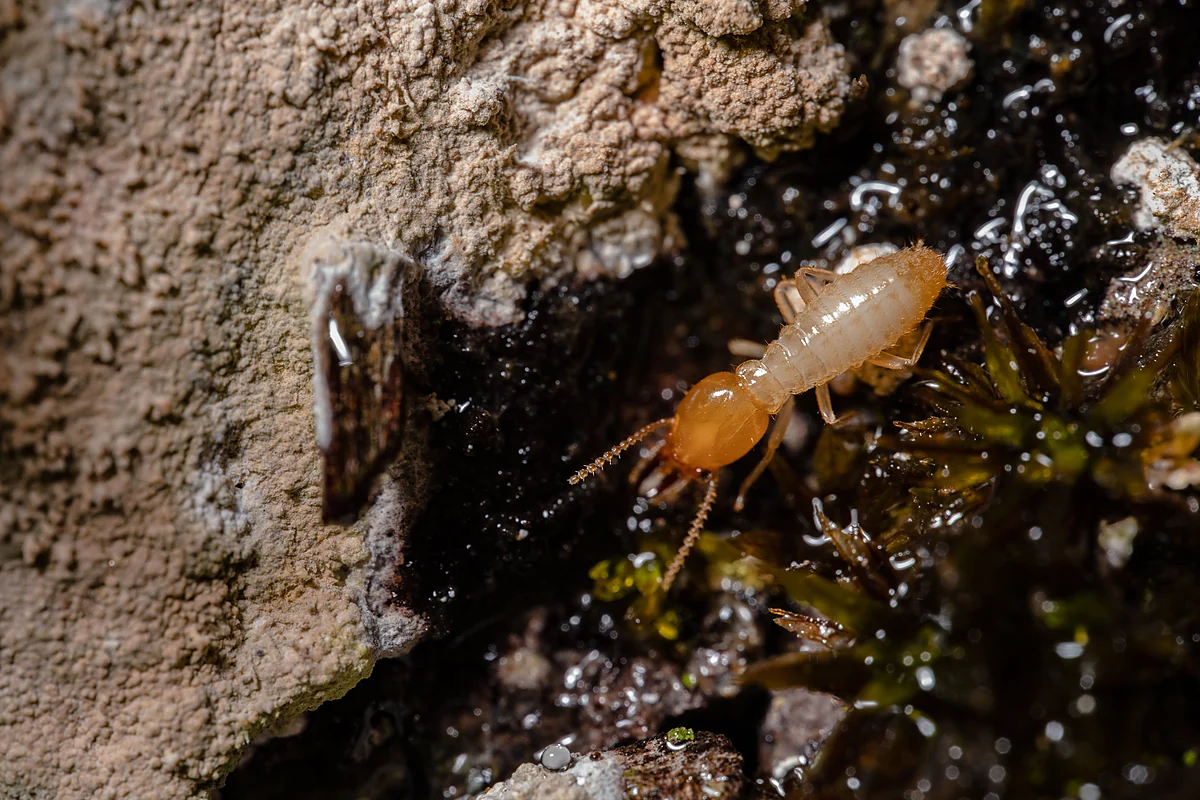
A termite. A pest inspection report will usually name the species.
Termite
Where It Nests
Risk to Buildings
Coptotermes acinaciformis
Inside living trees (often eucalypts), stumps, and sometimes under buildings or in walls. Colonies can hold more than a million termites.
High. Described by the Australian Museum as the most destructive termite species in Australia.
Schedorhinotermes species
Subterranean colonies in soil and timber.
High. Listed by the Queensland Government among the most damaging subterranean termites.
Nasutitermes walkeri
Rounded nests built on trunks and branches, mainly in stressed trees.
Low for houses. Can damage fences, poles and timber on the ground, but rarely attacks buildings.
The nest you can see on the outside of a trunk or in a branch fork is often Nasutitermes walkeri. It looks dramatic but is the lowest risk of the three. The species that concerns pest managers most, Coptotermes acinaciformis, usually nests out of sight inside the trunk or the root crown.
3. Can Termites in a Tree Spread to Your House?
Yes, they can, and distance is the part most people underestimate. Subterranean termites do not walk across open ground. They build tunnels through the soil, following roots, moisture, and anything made of timber, and they can cover a lot of ground doing it.
How Far They Travel
The Australian Museum notes that buildings within a 50 metre radius of a colony can be attacked. Early CSIRO field work on Coptotermes acinaciformis traced foraging galleries running around 48 metres from a colony.
So a tree at the back fence can still be the source of termites in your house, and a nest in a neighbour's tree can matter too. This is worth keeping in mind if your home backs onto bushland or a reserve, as many do around Forster, Old Bar and Hallidays Point.
How They Get Inside
Termites look for a concealed route. On a slab home, that can mean a crack in the slab, a gap around a pipe or service penetration, or a path behind cladding or garden beds piled against the wall.
Even a very fine crack can be enough, with gaps of around 1.5 mm often cited as wide enough for termites to pass through a slab. On homes with a suspended floor, they can build mud tubes up piers and walls to reach bearers and joists.
Homes are usually built with around 75 mm of slab edge left exposed and a gap below the weep holes, so that any mud tubes coming up the outside of the house can be seen during an inspection. When mulch, soil, paving or garden beds cover that zone, termites can get in without leaving any visible sign.
Swarming Flights
Mature colonies also send out winged termites to start new nests. CSIRO notes these flights happen on warm, humid nights, usually from late spring into summer. Most of these termites die, but a colony in a tree close to the house means more of them landing near damp spots like blocked gutters, leaking roofs, or poorly ventilated subfloors.
How Common Is It?
A CSIRO survey of more than 5,000 Australian homes found termites inside 16.3% of houses and somewhere on 35.6% of properties, including trees, fences and garden timber. In other words, termites on the block are common. What matters is whether they have a hidden way into the house.
Some signs are easy to spot from the ground. Others need a professional. The most common ones on MidCoast properties are:
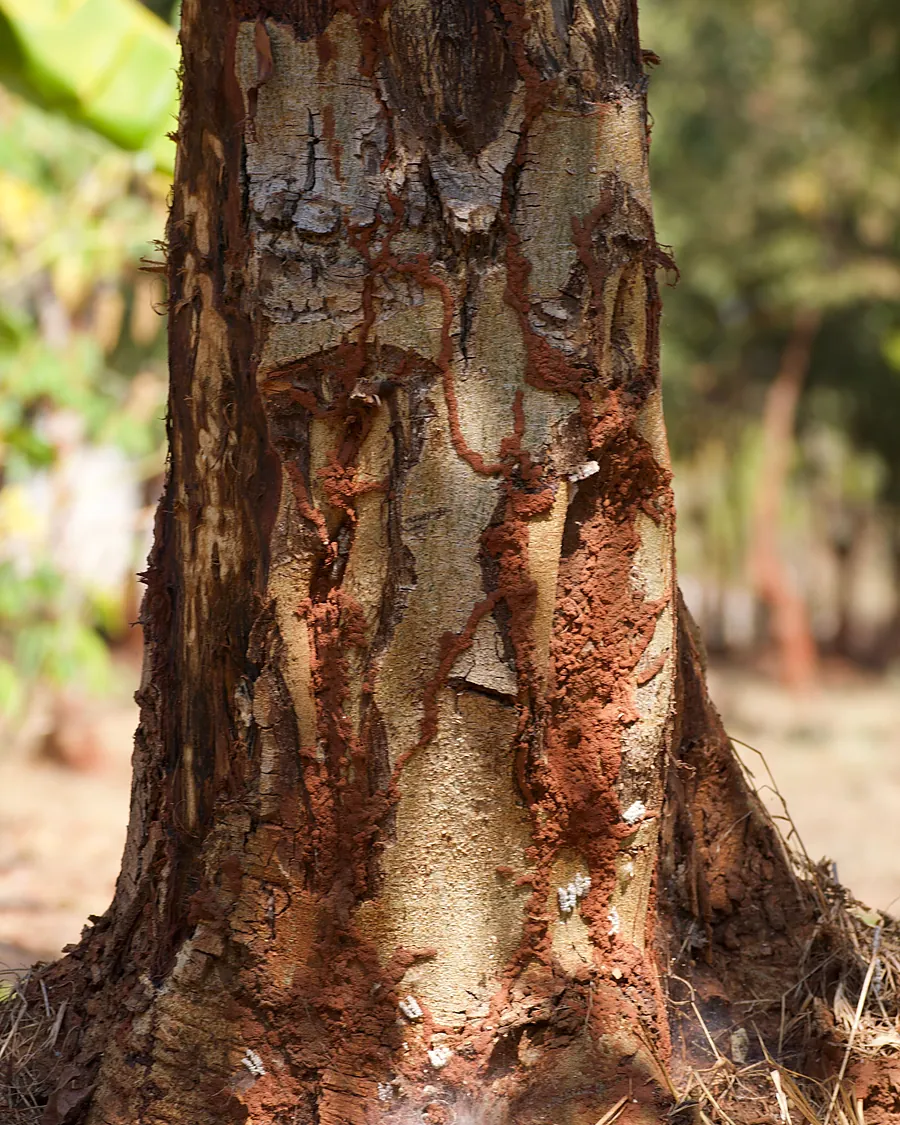
Mud tubes on the trunk. Look for brown, mud-like tunnels running up the bark or along exposed roots. Termites build these to stay protected as they travel, so fresh, moist tubes usually mean an active colony.
Nests on the outside of the tree. Rounded mud structures on the trunk or in a branch fork are hard to miss. As noted above, these are often the lower-risk Nasutitermes species, but they are still worth having identified.
Mud-packed holes or slits in the bark. Small openings sealed with fresh mud can show where termites have been working just under the surface.
Discarded wings. Small piles of see-through wings around the base of the tree, usually after a warm, humid night, are left behind after a swarming flight.
A hollow sound. A dull, hollow thud when you tap the lower trunk can point to a cavity inside, although it does not confirm termites on its own.
Live termites in soil or timber near the base. Pale, soft-bodied termites in disturbed soil, mulch, old stumps or garden edging around the tree are a clear sign a colony is close by.
Mud workings on the lower trunk are worth a closer look by a licensed pest manager.
Some nests show no outside signs at all. A licensed pest manager inspecting to AS 3660.2 will use a tapping tool, moisture meter and probe, and other non-destructive tools where activity is suspected. Where needed, a small test hole is drilled into the lower trunk to confirm whether there is an active nest inside.
A termite nest raises two separate questions. The first is about your house: are termites getting in? The second is about the tree: how much solid wood is left holding it up? A pest manager answers the first. An arborist answers the second.
Because termites hollow the trunk from the inside, a tree can keep a full green canopy while its strength drops. If that tree is within falling distance of the house, a shed, a driveway or a play area, the structural question matters just as much as the termites.
For other warning signs, see our guide to the 5 signs a tree is about to become a hazard.
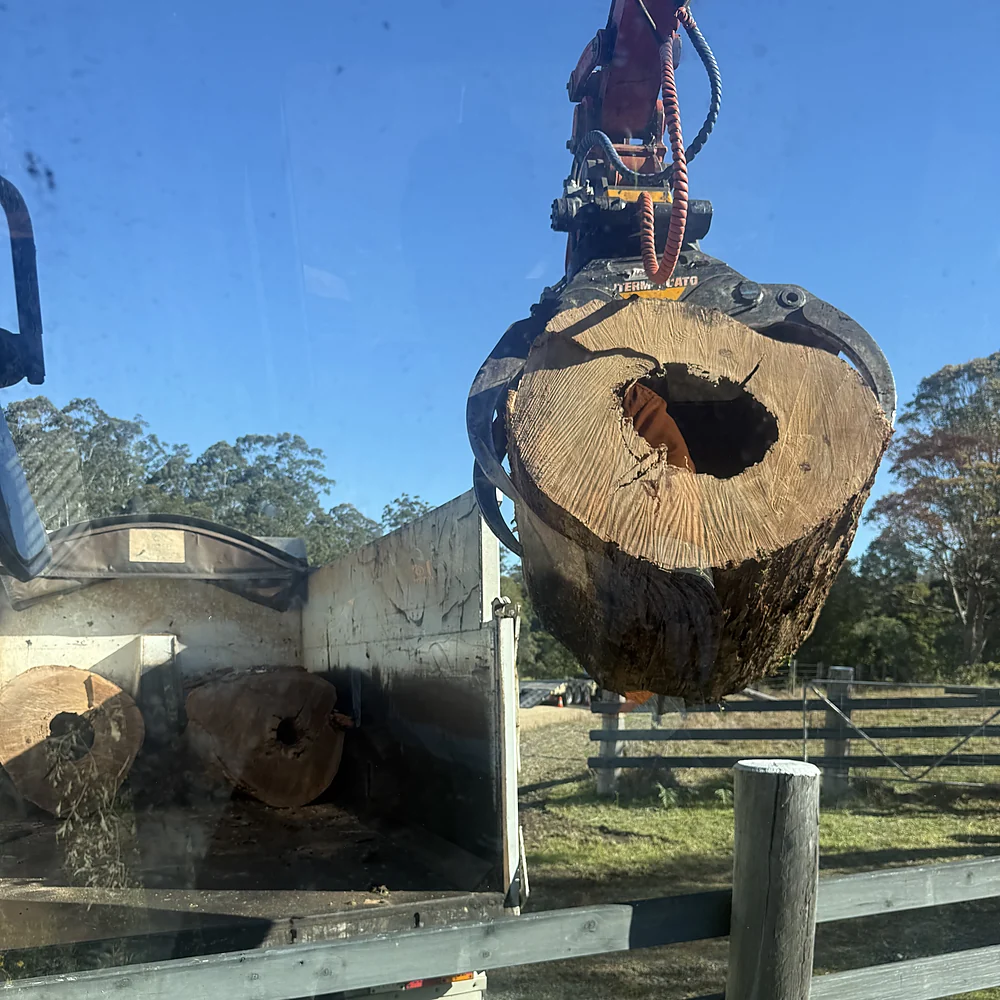
A hollow trunk section from a dead tree removal near Krambach. How much sound wood is left can only be judged by an assessment.
How Arborists Measure Hidden Decay
Arborists have a few tools for looking inside a trunk without cutting it down:
Visual tree assessment. Checking for cracks, bulges, cavities, fungal growth, dieback, lean, and root plate movement.
Resistance drilling. A very fine drill bit records how hard the wood is along its path, showing where sound wood ends and hollow or decayed wood begins.
Sonic tomography. Sensors placed around the trunk measure how sound travels through the wood. Sound moves more slowly through hollow or decayed wood, which gives a picture of the cross-section.
Arborists often refer to a guide developed by Claus Mattheck, which compares the thickness of the sound outer shell (t) with the trunk radius (R). In the original studies, trees with a t/R ratio of 0.3 or more did not fail.
Later research describes this as a useful rule of thumb rather than a strict cut-off, so it should be one tool among several, alongside the tree's species, height, lean, exposure to wind, and what it would hit if it fell.
If the assessment shows the tree still has enough sound wood, it can often stay, sometimes with careful tree pruning to reduce weight on long limbs. If not, removal may be the safer call. Either way, you are deciding on evidence, not guesswork. Our guide to what happens during a professional arborist assessment explains the process in more detail.
6. Treat the Colony First, Then Decide About the Tree
Cutting the tree down the moment termites are found is a common reaction. It feels decisive, but it does not deal with the actual problem.
A Coptotermes colony lives in the trunk, the root crown and the tunnels running out through the soil. Felling the tree does not necessarily kill the colony. It can also destroy the easiest place to treat it, since a nest inside a standing trunk can be reached directly.
AS 3660.2, the Australian Standard for termite management in and around existing buildings, puts the colony first. According to AEPMA's summary of the Standard, actions to eliminate a termite colony or reduce its numbers should be attempted before other measures.
How a Nest in a Tree Is Usually Treated
Treatment is a job for a licensed pest manager. Queensland Government guidance notes that nests in tree trunks can be drilled and treated where needed.
One common approach is to drill a small hole into the nest cavity and apply a termiticide dust, foam or liquid directly to the colony. Another is baiting, where a bait station is placed where termites are active. Worker termites carry the bait back to the nest and share it through the colony, which then slowly collapses.
Your pest manager will choose the method based on the species, how active the colony is, and where the nest sits in the tree. Treatment can take some time, so ask them how they will confirm the colony is dead.
Start with a pest inspection. Get a licensed pest manager to inspect both the tree and the house, confirm which species you are dealing with, and treat the colony.
Then check the tree's structure. Once treatment is under way or complete, have an arborist assess how much sound wood is left and whether the tree can safely stay.
Check for wildlife. Before any pruning or removal, look for hollows, nests or animals using the tree, and plan the work around them.
Plan removal carefully if it is needed. Talk to your pest manager about timing first. Then arrange tree removal and stump grinding, so an old stump is not left behind as food for the next colony.
7. How to Protect Your Home From Termites in Nearby Trees
You cannot stop termites living in the trees around you, especially on blocks backing onto bushland. What you can do is make it harder for them to get into the house unnoticed, and catch them early if they try.
Book regular inspections. AS 3660.2 sets routine inspections no more than 12 months apart, and more often in high-risk areas. Under the Standard, inspectors should also check trees with a trunk diameter of 200 mm or more within 50 metres of the building.
Keep the slab edge and weep holes clear. Leave the 75 mm inspection zone visible. Do not bank soil, mulch, paving or garden beds against the wall.
Move timber away from the house. Do not stack firewood, sleepers or building offcuts against or under the home.
Remove old stumps and dead wood near the house. They are food sources that can draw termites in close.
Fix leaks and moisture. Repair leaking taps, downpipes and air conditioner drains, and keep gutters clear.
Keep branches off the roof. Leaf litter in gutters keeps eaves damp, and branches touching the house give termites another route.
It is also worth checking your home insurance. CHOICE reported in April 2026 that more than half of the home insurance policies it analysed specifically exclude damage caused by termites, and many exclude all insect damage. For most households, early detection is the only real protection.
Once the colony has been dealt with, the next question is whether the tree is still safe to keep. MidCoast Tree Solutions can assess the tree on site and give you a clear recommendation, whether that is monitoring, weight-reduction pruning or removal.
Our arborists are AQF Level 5 qualified and we carry public liability insurance. If a storm has already brought a hollow tree or limb down, our emergency tree services team responds 24/7.